
The First Trimester Exercise No-No List
Knowing Which Exercises to Avoid During the First Trimester Could Protect You and Your Baby

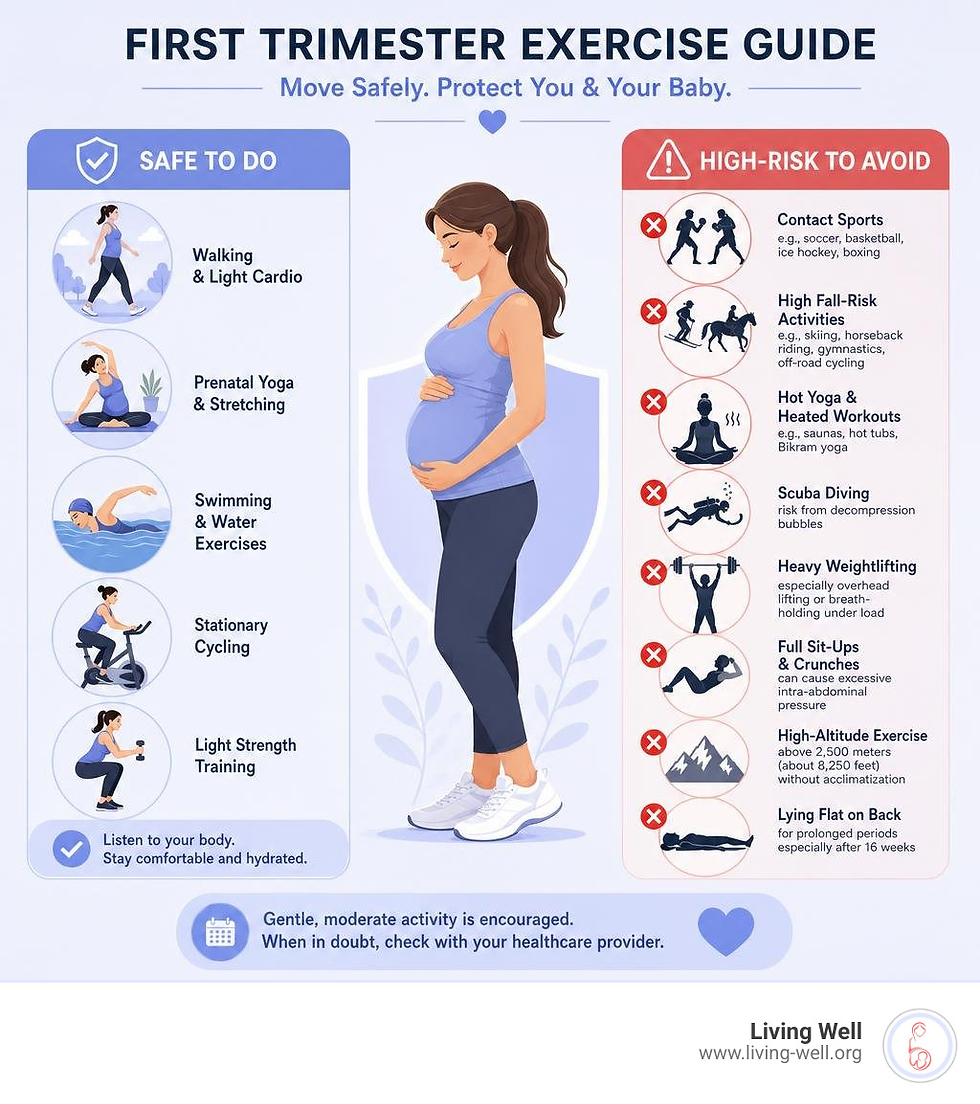
Knowing which exercises to avoid during the first trimester can make a real difference for both you and your growing baby. Here is a quick overview of the highest-risk activities:
Exercises and activities to avoid in the first trimester:
Contact sports — soccer, basketball, ice hockey, boxing
High fall-risk activities — skiing, horseback riding, gymnastics, off-road cycling
Hot yoga and heated workouts — saunas, hot tubs, Bikram yoga
Scuba diving — the fetus cannot filter gas bubbles from decompression
Heavy weightlifting — especially overhead lifting or breath-holding under load
Full sit-ups and crunches — can cause excessive intra-abdominal pressure
High-altitude exercise — above 2,500 meters (about 8,250 feet) without acclimatization
Lying flat on your back for prolonged periods — especially after 16 weeks
The good news? Gentle, moderate activity is not just safe — it is encouraged. The concern is not exercise itself. It is a specific handful of activities where the risks clearly outweigh the benefits in early pregnancy.
Most healthy pregnant women can and should aim for 150 minutes of moderate-intensity activity each week, as recommended by the American College of Obstetricians and Gynecologists (ACOG). The key is knowing what to skip — and why.
I'm Leo Kim, Executive Director of LivingWell Pregnancy Centers, and through our work supporting women navigating unexpected pregnancies since 1985, our team regularly helps clients understand safe prenatal wellness practices, including exercises to avoid during first trimester to protect both mother and baby. Read on for a complete, straightforward breakdown of what to avoid and what to do instead.
Understanding Body Changes and Exercise Safety in Early Pregnancy
During weeks 1 through 12, your body undergoes subtle yet profound changes long before a baby bump appears. Hormones flood your system, blood vessels dilate, and your cardiovascular system reorganizes itself to support developing tissue.

One of the most notable physiological changes is the rapid increase in the hormone relaxin. Relaxin works immediately in the first trimester to soften your ligaments and joint structures, particularly around the pelvis, to prepare your body for growth and labor down the road. While this internal softening is essential, it temporarily increases joint instability and makes you more vulnerable to sprains, strains, and balance loss.
At the same time, your circulatory system undergoes massive adjustments:
Blood volume increases significantly to transport oxygen to the developing fetus.
Resting heart rate rises, and your heart enlarges slightly to pump more blood per minute.
Progesterone expands blood vessel walls, which can naturally lower your blood pressure and make you more prone to sudden lightheadedness or fatigue.
Because your heart works harder even while resting, the gap between your resting heart rate and maximum exertion narrows. You might notice getting winded much faster during a simple stair climb or jog. To learn more about how your body adapts during these initial weeks, check out our article on An Invisible Miraculous Transformation: Body Changes in the First Trimester of Your Pregnancy.
To gauge your effort safely without stressing over heart rate monitors, exercise experts rely on the "talk test". If you can hold a clear, comfortable conversation while working out, you are operating within a safe, moderate intensity. If you become too breathless to speak in full sentences, your body is working too hard, and it is time to lower your pace. Medical authorities, including Medical News Today's first trimester exercise safety guide, recommend aiming for 150 minutes of moderate-intensity aerobic activity per week, ideally spread out over 20 to 30 minutes per day.
Major Categories of Exercises to Avoid During First Trimester

While staying active yields tremendous health benefits—such as reducing gestational diabetes risk, enhancing mood, and boosting energy—certain movement patterns carry clear medical risks during early pregnancy.
High-Impact and Contact Exercises to Avoid During First Trimester
Even though your developing embryo is nestled deep inside your pelvic bone during the first trimester, high-impact activities and contact sports remain strict non-starters. The main concern centers around acute abdominal trauma, extreme pressure shifts, and high risks of falling.
High-risk sports to eliminate immediately include:
Contact sports: Soccer, basketball, ice hockey, field hockey, martial arts, and boxing. In addition to direct physical impact, unexpected collisions can cause sharp torsions across the lower back and pelvis.
High fall-risk activities: Downhill skiing, snowboarding, gymnastics, off-road mountain biking, surfing, and horseback riding.
Because relaxin loosens your joints early on, your proprioception (your brain's sense of body positioning in space) shifts subtly. A sudden fall from a horse or bicycle puts severe mechanical strain on relaxed joints and increases the risk of pelvic injury or blunt abdominal force. For further reading on why contact and fall risks pose threats early on, review Science Insights on early pregnancy fitness risks.
Core Movements and Heavy Lifting Exercises to Avoid During First Trimester
Strengthening your core and maintaining muscle tone is fantastic, but traditional core workouts and max-effort heavy lifting must be adjusted during early pregnancy.
Full Sit-Ups and Double-Leg Raises: Classic full sit-ups, crunches, and heavy double-leg lifts significantly raise intra-abdominal pressure. This excessive internal pressure pushes outward against the midline abdominal wall (the linea alba), which can trigger or exacerbate diastasis recti (abdominal separation). Look out for "coning" or "doming"—a visible vertical ridge bulging along your belly midline during core movements. If you see coning, discontinue that exercise immediately.
Heavy Max-Effort Weightlifting: Pushing or pulling heavy weights (at 80% or more of your maximum capacity) often triggers the Valsalva maneuver—holding your breath while pushing against resistance. Breath-holding temporarily spikes intra-abdominal and blood pressure while briefly cutting off optimal oxygen delivery.
Overhead Lifting and Excessive Waist Bending: Heavy overhead presses place substantial compression strain on your lower back, which is already adapting to pelvic joint softening. Similarly, aggressive forward bending at the waist can provoke dizziness due to blood pressure shifts caused by progesterone.
Prolonged Supine Position (Lying Flat on Your Back): While short moments lying flat during the early weeks are generally harmless, prolonged workouts flat on your back should be phased out as you move toward the second trimester. Around 16 weeks, the weight of the uterus can compress the inferior vena cava—the major vein returning blood from your lower body to your heart—leading to sudden drops in blood pressure, nausea, and diminished uterine blood flow.
For additional clinical guidance on body mechanics and lifting, see the Pfizer guide to early pregnancy movement restrictions.
Environmental and Extreme Physical Hazards
Some fitness risks have less to do with movement and more to do with your environment:
Hot Yoga and Heated Workouts: Bikram yoga, hot Pilates, saunas, hot tubs, and intense outdoor workouts in high heat pose serious developmental hazards. Research shows that elevated maternal core body temperature exceeding 102°F (38.9°C) for over 10 minutes—especially during the first trimester when neural tube formation occurs—roughly doubles the risk of neural tube defects in infants.
Scuba Diving: Scuba diving is strictly contraindicated throughout pregnancy. A developing fetus lacks the pulmonary structures needed to filter gas bubbles, leaving the baby entirely unprotected against decompression sickness and gas embolism in the bloodstream.
High-Altitude Workouts: Exercising at altitudes above 2,500 meters (about 8,250 feet) without 4 to 5 days of proper acclimatization limits oxygen availability, putting unnecessary stress on both mother and baby.
Warning Signs to Stop Exercising Immediately

Listening to your body is your most effective safeguard. Regardless of how fit you felt prior to conceiving, you should halt your workout immediately and contact your healthcare provider if you experience any of the following warning signs:
Vaginal bleeding or spotty discharge
Dizziness, lightheadedness, or feeling faint
Chest pain or unexplained palpitations
Shortness of breath before initiating exertion
Severe, persistent headache
Fluid leakage from the vagina
Calf pain, swelling, or localized tenderness (which could signal a deep vein blood clot)
Regular, painful uterine contractions or strong pelvic cramps
Sudden muscle weakness affecting your balance
If you are wondering about timelines and symptoms as your pregnancy develops, consult our breakdown on How Long First Trimester lasts and what changes to expect.
Safe Alternatives for Remaining Active in Early Pregnancy
Transitioning away from high-risk workouts does not mean sitting on the sidelines. Replacing unsafe movements with gentle, highly effective alternatives keeps you feeling strong, energized, and grounded.
Unsafe Exercise / Activity | Primary Risk / Hazard | Safe Early Pregnancy Alternative |
Contact Sports & Fall Risks (Soccer, Skiing, Horseback Riding) | Abdominal trauma, joint damage, sudden fall impact | Brisk Walking & Stationary Cycling (Smooth, low-impact cardio without balance risks) |
Hot Yoga & Heated Studios (Bikram Yoga, Saunas) | Maternal hyperthermia, doubled risk of neural tube defects | Prenatal Yoga in Temperature-Controlled Rooms (Promotes flexibility, breathwork, and pelvic opening safely) |
Full Sit-Ups & Crunches | Abdominal coning, diastasis recti, high intra-abdominal pressure | Bird-Dogs, Pelvic Tilts & Side Planks (Deep core activation without abdominal strain) |
Heavy Weightlifting & Breath Holding | Spikes in intra-abdominal pressure, reduced fetal oxygen flow | Light Resistance Training & Bodyweight Squats (Builds endurance with exhales on effort) |
Scuba Diving | Fetal decompression sickness and gas embolism | Swimming & Water Aerobics (Buoyant, zero-impact cardiovascular support) |
To protect your core and pelvic floor, incorporate functional stability exercises rather than static tightening. Techniques such as diaphragmatic breathing paired with gentle pelvic floor releases help preserve joint health and ease common early symptoms. For specialized pelvic guidance, read Dr. Kayla Borchers' Functional Pelvic Floor Guide.
If morning sickness or fatigue makes full 30-minute workouts challenging, break your physical activity into two 15-minute walks. For tips on managing fatigue alongside early symptoms, explore Now That You're Expecting: 6 Pregnancy Symptoms After a Pregnancy Test.
Frequently Asked Questions About First Trimester Fitness
Can exercising in the first trimester cause a miscarriage?
No. For uncomplicated pregnancies, moderate physical activity does not cause miscarriage, early pregnancy loss, or low birth weight. Miscarriages in the first trimester are overwhelmingly caused by chromosomal abnormalities that occur at conception, not by walking, light strength training, or low-impact exercise.
ACOG and major medical institutions affirm that regular physical activity is far safer for pregnancy outcomes than remaining sedentary. The only workouts that elevate pregnancy loss risks are extreme high-intensity workouts (operating at over 80-85% max capacity regularly), workouts causing heat stroke, or activities resulting in direct abdominal injury. You can learn more about early embryonic growth in our resource From Conception to Fully Formed: Your Baby's Development in the First Trimester.
Why should I avoid lying flat on my back while working out?
When you lie flat on your back (the supine position), the weight of your growing uterus rests directly on the inferior vena cava, the major vein responsible for transporting blood back up to your heart.
Compressing this vein can quickly reduce blood flow back to your heart, causing a sudden drop in blood pressure. This can make you feel lightheaded, nauseous, or dizzy while temporarily reducing oxygen and blood flow to the placenta. While brief moments on your back in weeks 1 through 8 are unlikely to cause issues, transitioning to side-lying positions, elevated angles, or standing exercises by week 16 is recommended.
Is it safe to lift weights or do core workouts early in pregnancy?
Yes, provided you modify your weight loads and exercise selection:
Weightlifting: Switch from heavy max-effort sets to lighter resistance with higher repetition ranges. Focus on controlled movements, use a double-leg stance for pelvic stability, and never hold your breath during a lift. Exhale during exertion and inhale as you lower the weight.
Core Work: Skip traditional crunches, sit-ups, and full belly twists. Instead, choose deep stability movements such as bird-dogs on hands and knees, pelvic tilts, side planks, and seated band rows. Always monitor your midline for coning.
Conclusion
Staying active during your first trimester should be an empowering, comforting experience—not a source of stress. By making simple adjustments and recognizing exercises to avoid during first trimester, you protect your physical health while setting a strong foundation for the months ahead.
If you recently discovered you are pregnant—or suspect you might be—and feel overwhelmed by conflicting advice, you do not have to navigate it alone. At LivingWell, we understand that an unexpected or early pregnancy brings a wave of questions. Since 1985, our non-profit clinic has offered warm, supportive, and completely non-judgmental medical care to women across our community.
We provide free medical-grade pregnancy testing, free obstetric ultrasounds performed by licensed nurses and ultrasound technicians, and confidential consultation with licensed healthcare professionals. In 2025 alone, our team proudly served 1,420 local women, offering clear information and caring support in a quiet, confidential environment.
Whether you need to confirm your pregnancy, determine how far along you are, or talk through your options with a compassionate team, we are here for you.
Visit us today at 2010 N Tustin St, Suite C, Orange, CA 92865 or explore our services online at LivingWell Pregnancy Support. You can also browse our free resources on our Pregnancy Education Blog or schedule a Free Pregnancy Test Service today. Let us help you take your next steps with confidence and peace of mind.


Comments